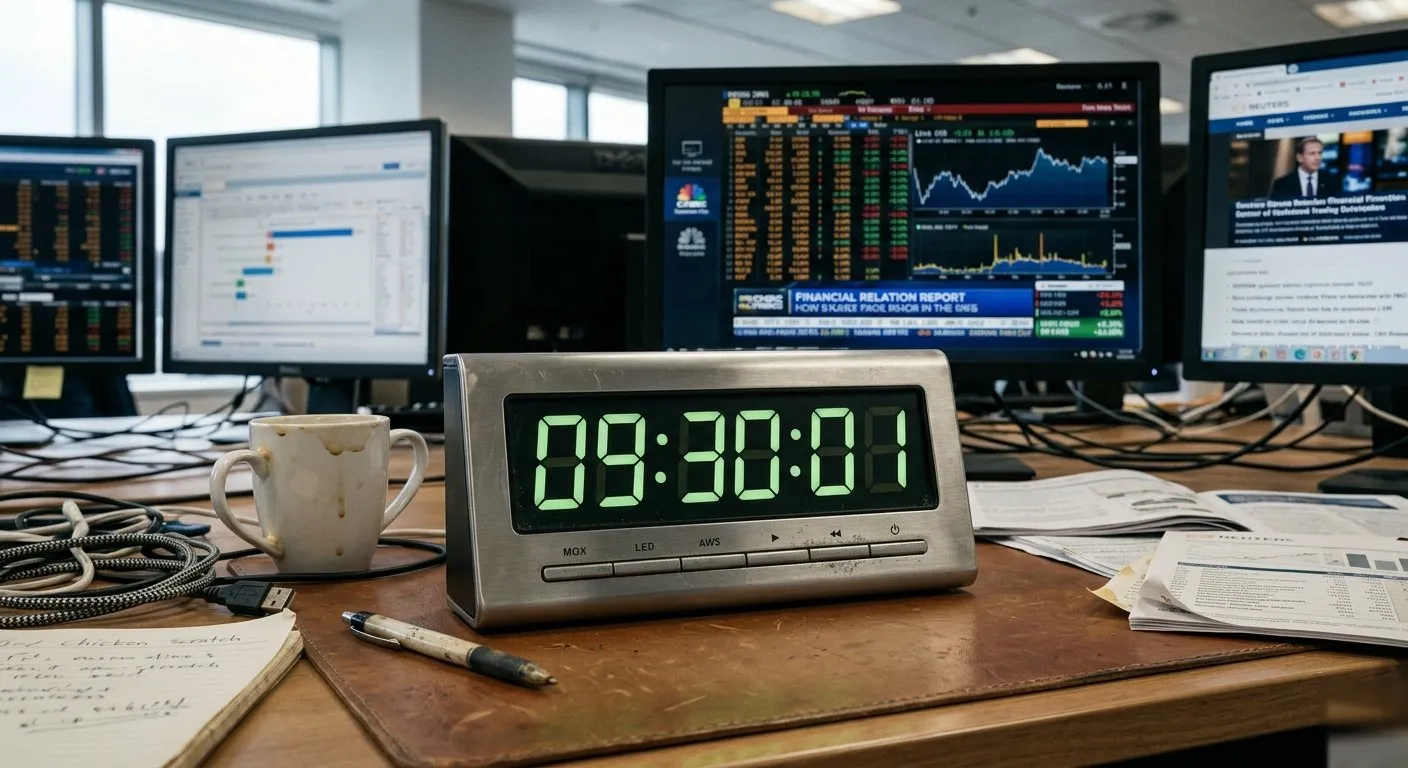
The Timing Edge: Why Speed Matters in Insider Trading Signals
May 28, 2026 · InsiderSignals · 6 min read
Updated: June 10, 2026
The value of an insider trading signal decays rapidly after the SEC filing date. Investors who see the data days or weeks later have already lost most of the informational edge.
The chain of events works like this: an insider buys stock, and under SEC rules they have two business days to file a Form 4. The filing becomes publicly available on EDGAR. At some point after that, investors see it through a screener, a newsletter, a media article, or a social media post.
That chain contains multiple time gaps, and each one erodes the value of the information. Understanding insider trading signal timing is essential for anyone using this data as an input to their investment process. It matters most for the high-conviction insider signals that have historically outperformed the market, because those are exactly the trades that fast market participants act on first.
The disclosure timeline
The clock starts when the insider executes the trade. Here's how the timeline typically plays out:
Day 0: Transaction. The insider buys (or sells) stock on the open market. The trade is executed through their broker and appears in normal market flow. At this point, nobody outside the insider and their broker knows the trade happened.
Day 0 to Day 2: Filing window. SEC rules require the Form 4 to be filed within two business days. In practice, many filings arrive on the same day as the transaction. Others arrive on Day 1 or Day 2. A small percentage arrive late, which the SEC requires to be flagged.
Day 2 (typically): EDGAR publication. Once filed, the Form 4 appears on the SEC's EDGAR system. It's now public information. Anyone who monitors EDGAR in real time has access.
Day 2 to Day 14+: Distribution. Most investors don't monitor EDGAR directly. They rely on downstream sources: financial data providers ingest EDGAR filings and push them to screeners and dashboards. Financial media may cover notable purchases. Newsletter writers include them in weekly or monthly roundups. Social media accounts post highlights.
This distribution lag is where most of the signal value gets lost. For investors outside the US, particularly in Europe where SEC filings receive almost no mainstream media coverage, the lag can be even longer. Most EU-focused financial media doesn't cover individual Form 4 filings at all.
What the research says about timing
The Wall Street Journal's February 2026 analysis of 1,400 insider purchases found a median gain of 2% at 30 days post-filing, with the signal fading after that. The Verity researcher quoted in the article observed that the bullish signal "sort of wears off."
An independent backtest on r/ValueInvesting found similar dynamics but with sharper timing resolution: the signal was statistically significant at 5 to 10 days post-filing but had disappeared by 30 days. At 60 to 90 days, the average insider purchase actually underperformed the S&P 500.
Read those two findings together and a pattern emerges. The informational content of an insider purchase is highest immediately after filing. It decays rapidly. By the time most investors encounter the data (through a weekly newsletter, a delayed screener update, or a news article published days after the filing), the window of maximum informational value has narrowed or closed.
This doesn't mean the information is worthless by Day 14. It means the excess return specifically attributable to the insider signal has been partially absorbed by faster market participants. The stock hasn't "moved past" the information. The information has been priced in by the people who saw it first.
Why the gap exists
EDGAR is technically accessible to anyone. Filings are published in real time as XML and HTML documents. In theory, every investor has equal access.
In practice, the gap between "publicly available" and "practically accessible" is significant.
Institutional participants often have automated systems that parse EDGAR filings within minutes of publication. They can evaluate and act on new Form 4 data almost immediately. Quantitative funds have been doing this for years.
Data aggregators typically process filings within hours to a day. Services like Finviz, WhaleWisdom, and others ingest EDGAR data and present it in more readable formats. But there's processing time, and the presentation is usually undifferentiated: all filings shown equally, without filtering or prioritization.
Media and newsletters operate on editorial cycles. A notable insider purchase filed on Monday might appear in a newsletter on Thursday or a news article the following week. By then, the short-term signal has already played out.
Social media is faster but inconsistent. Finance accounts on X and Reddit sometimes highlight insider purchases within hours. But coverage is sporadic. It depends on whether a given trade catches someone's attention, not on systematic monitoring.
The result is a tiered information distribution. The same public data reaches different market participants at different times, over a window that can stretch from minutes to weeks. The value of the signal is inversely proportional to how long it takes to reach you.
Speed without filtering is just fast noise
If timing were the only variable, the solution would be simple: set up an EDGAR parser and react to every filing as fast as possible. But speed alone creates its own problem, because you'd be reacting to every Form 4, including the ones that contain no meaningful signal.
The SEC processes roughly 13,000 Form 4 filings per month. The vast majority are routine: stock option exercises, tax withholding transactions, automatic plan purchases, small director buys. Only a fraction represent the kind of discretionary, high-conviction purchases that the research shows carry informational value.
Acting on every filing quickly is just fast noise. The meaningful advantage comes from being fast and selective: identifying the small subset of filings that are genuinely unusual and getting that filtered information in front of investors while the signal is still fresh. This is why real-time insider trading alerts are only useful when they're built on filtering, not raw volume.
This is the core challenge: the raw data is publicly available and arrives quickly, but it requires processing and filtering before it's useful. The time it takes to do that processing determines how much of the original signal remains when the investor sees it.
The signal decay curve
Think of the informational value of an insider purchase as a curve that peaks at filing and decays over time. The shape of that curve depends on the trade:
High-conviction trades (large, discretionary, from senior insiders, during price weakness) tend to have a steeper initial peak. They carry more information, and the market responds more quickly once the filing is public. The first 24 to 48 hours after filing contain the most momentum.
Routine trades (small, scheduled, from lower-tier insiders) have a flatter curve, because there's less information to decay. These filings don't move markets regardless of when you see them.
Cluster buys (multiple insiders purchasing within a tight window) create a compounding signal. Each subsequent filing reinforces the pattern, and the market may not fully price in the cluster until all filings are published. This creates a slightly longer window of informational value, one reason cluster patterns show up as stronger in backtests.
The practical implication: the higher the conviction behind the trade, the more time-sensitive it is. Elite-tier trades are the ones most likely to be acted on quickly by sophisticated market participants, which means they're also the ones where access speed matters most.
What this means for retail investors
The timing dynamic isn't a reason to avoid insider trading data. It's a reason to be thoughtful about how you use it.
If you're finding out about insider purchases through a weekly newsletter or a month-end roundup, you're likely seeing the signal after the short-term informational content has been absorbed. The data still tells you something about insider sentiment and conviction, but the tactical value is lower.
If you're monitoring insider purchases closer to the filing date and filtering for the high-conviction subset (C-suite buyers, large discretionary purchases, cluster patterns), the informational window is wider. The data is more useful when it's both recent and filtered.
The core tension is between breadth and speed. Seeing every filing with a two-week delay gives you breadth but no timing edge. Seeing only the Elite and Strong tier trades within hours of publication gives you both, but that requires infrastructure most retail investors don't build for themselves.
The data is public and the signal decays, and the value lives in the gap between those two facts.
Related Reading
- WSJ Analyzed 1,400 Insider Buys. Here's What They Missed.: What the headline studies on signal decay measured, and the filtering step they skipped.
- What Happens When You Invest $100 in Every High-Conviction Insider Signal for a Decade: The decade-long simulation of acting on Elite and Strong signals from the filing date.
- How to Read an SEC Form 4 Filing (And What Most Investors Miss): Where the two-day disclosure clock starts, explained field by field.
For informational purposes only. Not investment advice.